
Deepening engagement through the expressive arts
Discovering healing circles was one of the best gifts I’ve ever received, coming at a point in my life when I deeply needed a caring, authentic, and creative community. I’d had a long career in higher education, flourishing in a culture of interdisciplinary collaboration and innovation. Sadly, when the leadership changed, so did our foundation of support and trust. After a few years of hoping things would improve, I felt I had to resign, leaving me distrustful of organizations in general and unsure of my place in the world.
Soon after, just as the global pandemic was taking hold in 2020, my friend Maureen asked if I wanted to join her in learning an online approach to group engagement called Healing Circles. Now, after five years of learning, experimenting, and practicing within the Healing Circles Global organization, Maureen and I are happily co-hosting a monthly expressive arts circle. I’ve found an inspirational home within the HCG community and a vibrant cohort of friends on the Expressive Arts (EA) team.
The intention of expressive arts circles is the same as all other healing circles: to provide a safe, respectful, and confidential environment in which participants can explore and share their inner thoughts and feelings without feedback, advice, or comment. The difference is that expressive arts circles calls on members to tap into their creative/imaginative capacity for exploring their personal stories as well as our shared humanity. Participants are invited to use the different “languages” of expression: the imaginative or creative modalities that go beyond the extemporaneous speaking that’s typical of most healing circles. These somatic practices, in turn, stimulate the use of metaphor, imagination, and spontaneity.
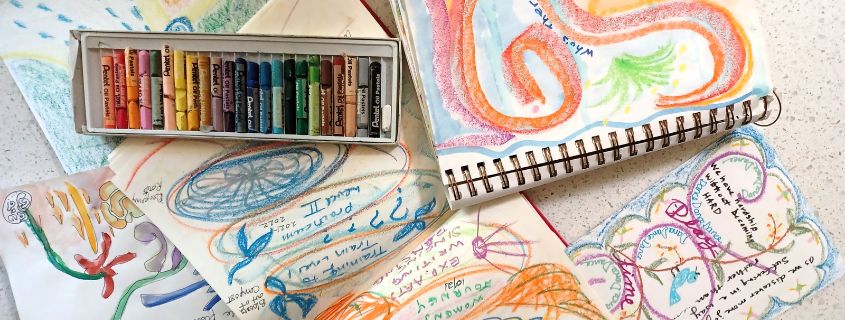
For example, as a prelude to the heart-share round, we invite participants to take 20 minutes offline (with their audio muted and video off) to explore the offered prompt through drawing, writing, moving, vocalizing – whatever mode(s) they choose in that moment. Typically, participants will draw, paint, or write in response to the prompt (often in combination). Sometimes they choose to walk in their garden or engage in a mindfulness meditation. With the sound of a bell, we’re called back into our communal space, where we share whatever we experienced or discovered. People are welcome to read or show what they’ve created, share the process of their exploration and what that revealed, or share the insights, thoughts, and emotions that arose for them during that time. Everyone is welcome to pass if they choose, or ask for “silence between two bells,” during which we simply sit in silent solidarity with the sharer.
Beyond the personal experience of engaging in the expressive arts, our EA circles illuminate both the diversity and commonality of our collective thoughts and expressions; we all hear and see the same prompt on the Zoom screen, yet the time we spend alone in expressive exploration reveals vastly diverse perspectives that, through sharing, reveal a complex and often poignant whole. Therein lie the threads that connect us as a healing community.
There are thousands of books, articles, workshops, and videos addressing the theory and practice of expressive (or creative) arts methods, most viewed through the lenses of psychotherapy, medicine, or social action. Here, though, I’d like to share a few things that we, as healing circle co-hosts, can implement to invite a bit of creative embodiment into the traditional four-round circle format.
Deepening engagement with warm-ups
Warming up is as important for creative reflection as it is for physical exercise; each round of a healing circle can be a warm-up for the next round. When participants are warmed up to explore more deeply, they feel safer and more spontaneous in their exploration. For example, as a warm-up to the heart-share prompt Small Kindnesses, I asked participants to check in during the welcome round with a “small kindness” they had witnessed or experienced recently.
Connecting check-in and check-out prompts
We can also develop check-in prompts that gently tap into memory or sensation and warm up to the somatic experience that precedes heart-sharing. Relating check-in and check-out questions to each other helps bring the experience full circle for participants.
For example:
- Check-in: If you could invite someone to share this circle with you today, who would it be, and why would you like them to be here with you?
- Check-out: Remember the person you invited to share the circle with you today? How do they feel now that they’ve shared this experience with you?
- Check-in: If we were able to share a potluck meal in our circle today, what would you want to contribute and why?
- Check-out: How was the potluck we shared today? Is there a particular “taste” you’d like to take home with you?
Sparking spontaneity through free-writing
Free-writing is a timed, stream-of-consciousness writing strategy that can be very effective in transitioning from one round to the next, allowing each person a few quiet minutes to reflect on what they’ve experienced thus far, or warm up to the next prompt. (It can be reassuring for participants to know that the writing is for their own self-exploration, with no expectation of sharing what they’ve written.)
I hope these ideas have sparked your imagination and creativity, and that you’ll explore ways to invite expressive techniques into your own circles. If you’d like more ideas or mentoring, please contact us.
In the photo above, Jackie Fowler shares some of the things she wrote and drew during the circles she co-hosts.

